Research Focus
We investigate the cellular and molecular mechanisms underlying atherosclerotic cardiovascular disease (ASCVD), with the overarching goal of identifying novel regulators of vascular inflammation and atherosclerosis. Leveraging insights from human cardiovascular genetics, we investigate the functions of disease-associated genes and dissect their cell-type-specific mechanisms using state-of-the-art multi-omics approaches, molecular and cellular biology, functional and epigenetic assays, including chromatin immunoprecipitation sequencing (ChIP-seq), and transgenic animal models. Specific goals include: 1) dissecting the mechanisms linking human CVD risk loci to arterial inflammation; 2) assessing macrophage-endothelial cell crosstalk in lipid uptake and intracellular processing; 3) scrutinizing the assembly of protein complexes controlling innate immune cell activation and 4) decoding the epigenetic mechanisms regulating innate immune reprogramming in atherosclerosis.
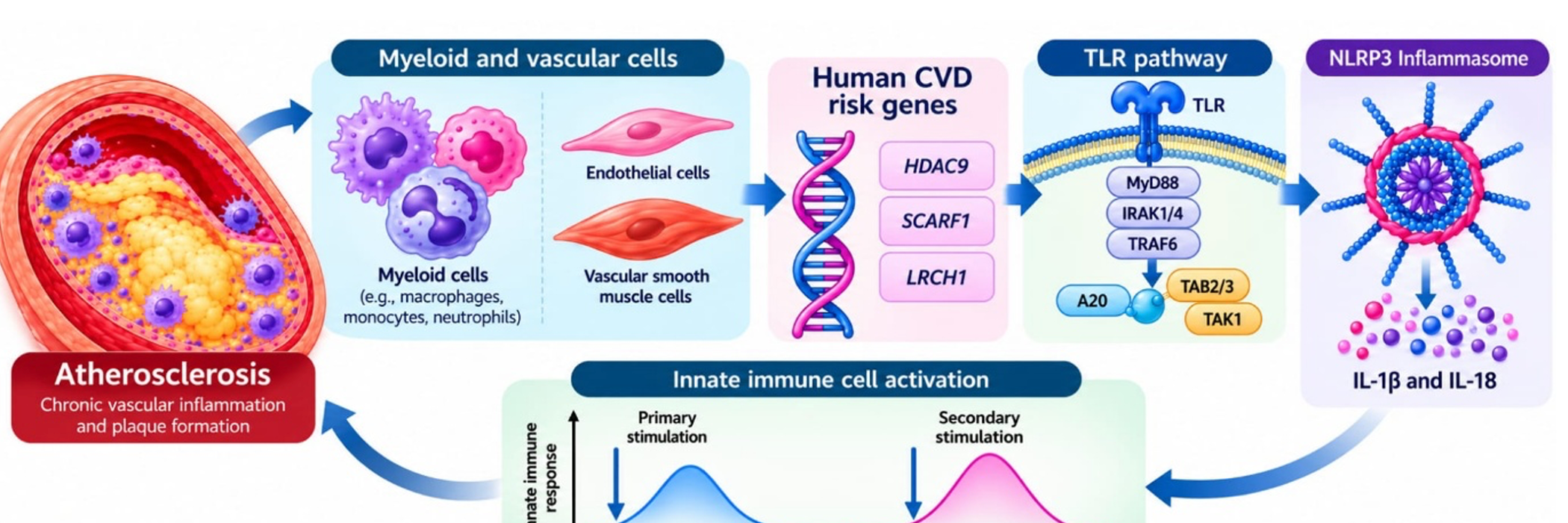
Leveraging human genetic risk loci to uncover mechanisms of atherosclerosis
We leverage human genetic discoveries at cardiovascular disease risk loci to investigate the roles of associated genes (e.g. HDAC9, SCARF1, and LRCH1) in vascular inflammation and atherosclerosis. Using animal models and primary human cells, we establish their functional relevance and dissect the molecular mechanisms linking genetic risk to disease, with the ultimate goal of identifying novel therapeutic targets for vascular protection. A particular focus of our research is on inflammatory pathways central to atherogenesis, including TLR and inflammasome activation, which we have identified as downstream effectors of genetic risk loci associated with human atherosclerosis.
Macrophage-endothelial cell crosstalk in lipid uptake and intracellular processing
A second research focus is the uptake and transcytosis of LDL across the vascular endothelium, as well as its subsequent uptake and intracellular processing by macrophages. We are particularly interested in understanding how class F scavenger receptors, which possess a unique cytoplasmic tail, orchestrate these processes and activate downstream signaling networks upon ligand–receptor binding. The unusually long cytoplasmic tail of these receptors suggests that they may function not only as lipid transporters but also as signaling receptors, potentially linking lipid uptake to intracellular inflammatory signaling and lipid metabolism.
Epigenetic modulation of innate immune cells
Reprogramming of innate immune cells has been implicated in atherosclerosis, opening new therapeutic possibilities. However, the underlying molecular mechanisms remain poorly understood. A third research focus is the epigenetic and functional reprogramming of innate immune cells in the bone marrow and atherosclerotic plaques, and its contribution to chronic inflammation in ASCVD. We have recently established epigenetic assays that enable us to dissect the molecular mechanisms governing immune cell activation in atherosclerosis.
Assembly of protein complexes controlling innate immune cell activation
We recently showed that the cardiovascular risk gene HDAC9 interacts with the NF-κB-activating kinases IKKα and IKKβ, promoting their deacetylation and subsequent activation, thereby driving inflammation in atherosclerosis. We further found that IKKβ directly interacts with NLRP3 to promote rapid inflammasome activation, and that HDAC9 also interacts with NLRP3. Together, these findings raise the possibility that HDAC9, IKK, and NLRP3, and their molecular interactors, may form larger complexes that regulate innate immune cell activation, providing the rationale for this research focus.
Asare Y, Vijayan S, Shagdarsuren G, Shagdarsuren E. Complement Blocking Therapeutic Strategies: A Prospective Approach for the Treatment of Cardiovascular Diseases. Frontiers in Cardiovascular Drug Discovery 2016, Vol 3 (Book Chapter)
We gratefully acknowledge support for our work by the following funding agencies:
10.24.2.001MN: Bidirectional regulation of HDAC9 and IKK in chronic inflammation

AS 575/1-1: Role of SCARF1 in arterial inflammation
CRC1123/3 [Project B3]: Yaw Asare / Martin Dichgans – Mechanistic role of HDAC9 in atherosclerosis
Excellence program for research and funding (FöFoLe, LMU)

Friedrich-Baur-Stiftung (LMU)
2017 & 2020
Yaw Asare, Team Leader
Arailym Aronova, Postdoc
Federica Tosato, Postdoc
Christina Schlegl, MD student
Luka Zivkovic, MD student
Margarita Shnipova, MSc student
CV
Yaw Asare, PhD
Originally from Ghana, I studied biochemistry, biomedical engineering, and vascular biology. My research ambition is twofold: 1) understand inflammatory mechanisms in atherosclerosis as a major cause of ischemic stroke; and 2) identify novel druggable targets for vascular protection (Asare et al. Circ Res 2020; Asare et al. PNAS 2017). This is an effort guided by human genetics and we pursue it from basic science to preclinical translation.
Scientific Vita
01/2022
Team Leader, Experimental Atherosclerosis Research, Institute for Stroke and Dementia Research, LMU Hospital, Munich Germany
09/2014 –12/2021
Postdoctoral Investigator & Senior Scientist, Institute for Stroke and Dementia Research, LMU Hospital, Munich Germany
10/2012 – 08/2014
Postdoctoral Investigator with shared affiliation at Institute of Biochemistry and Molecular Cell Biology & Institute for Molecular Cardiovascular Research, both RWTH Aachen University Hospital
09/2012
PhD thesis "Role of COP9 Signalosome and IKK complex in Atherosclerosis", Center for Biochemistry, RWTH Aachen University, Germany (Prof. Dr. J. Bernhagen)
2006 – 2008 MSc Biomedical Engineering, RWTH Aachen University, Germany
2001 – 2005
BSc Biochemistry, KNUST, Kumasi, Ghana
Honors & Awards
- Finalist Young Investigator Award of the German Society for Microcirculation and Vascular Biology (2017)
- BRAIN & BRAIN PET Early Career Investigator Travel Award (2017)
- European Vascular Biology Organization (EVBO) Travel Award (2012)
- European Society for Microcirculation (ESM) Travel Award (2011)
- Signal Transduction Society (STS) Travel Award (2011 & 2009)
- PhD scholarship from the German Research Foundation (2008)
- GARG Foundation Scholarship (2006)
- DAAD Scholarship (2005)
Fields of interest
- Atherosclerosis
- Vascular Injury
- Inflammatory Mechanisms
- Macrophage Biology
Yaw Asare
Tel: +49-89-4400-46170
yaw.asare@med.uni-muenchen.de